

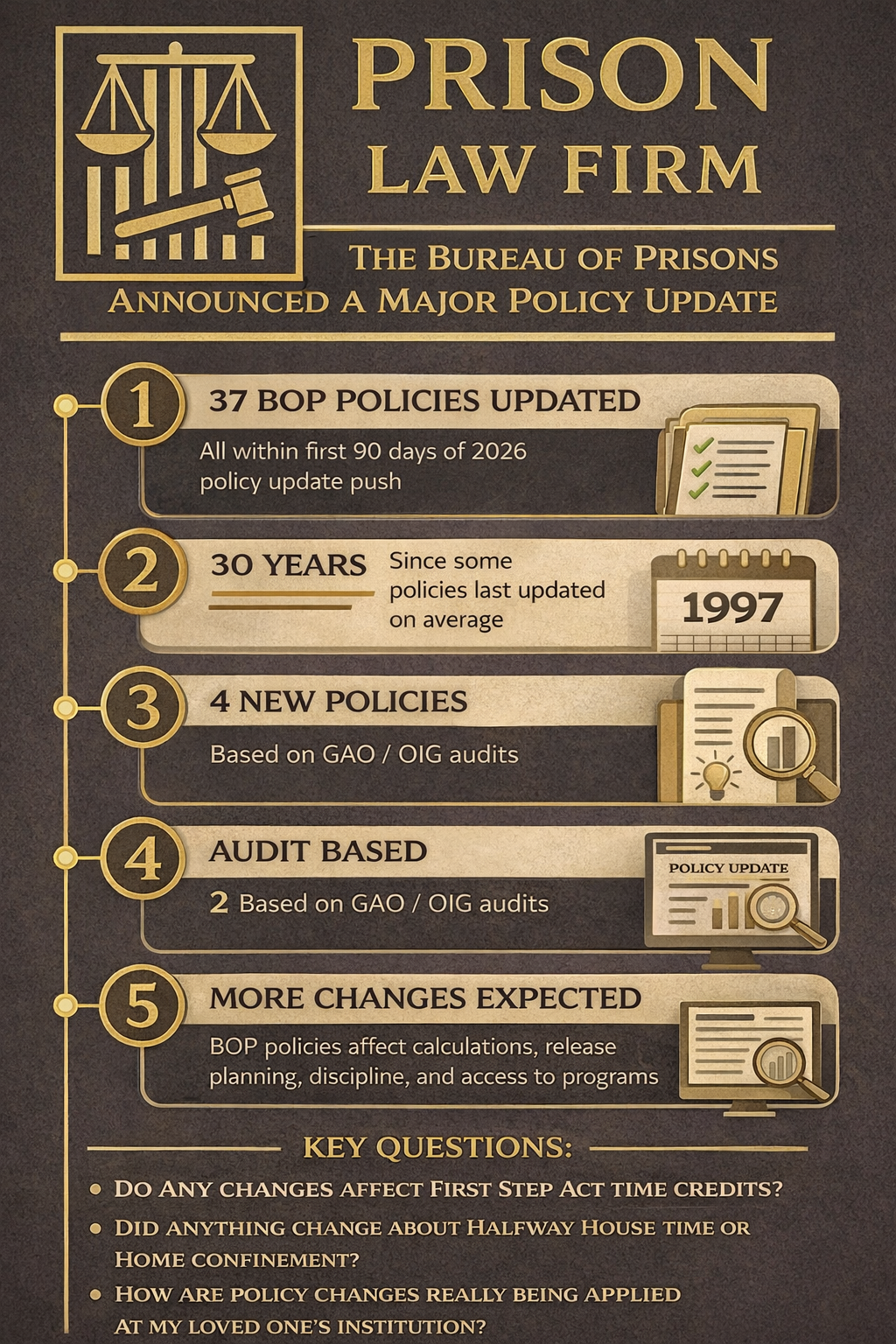
The Bureau of Prisons says it updated 37 policies in just 90 days. That is a huge development. For federal prisoners and their families, policy changes are never just paperwork. They can affect release planning, First Step Act credits, halfway house time, home confinement, discipline, medical access, visitation, and how staff respond when something goes wrong.
According to the BOP, these 37 policies had gone an average of more than 12 years without being updated, and the oldest had not been updated since 1997. The agency described the effort as one of the most significant modernization pushes in nearly 30 years. That sounds administrative, but inside prison walls, “policy” often means the difference between getting relief quickly and getting stuck in red tape for months.
That is why this matters now. If the Bureau is rewriting old rules, prisoners and families need to pay close attention to how those changes are actually applied on the ground—not just how they are announced in Washington.
What the BOP confirmed
The BOP’s March 2026 announcement confirmed a few key facts:
- 37 policies were completed in the first 90 days of the agency’s renewed policy effort,
- the average age of the policies was over 12 years,
- the oldest had not been updated since July 1997,
- two updates were tied to unresolved GAO or OIG audit issues, and
- four were entirely new policies.
The BOP also says updated policies are being made available through its public policy portal. In other words, this is not a one-time announcement. It is part of an ongoing change process, and more updates are expected. View Here >>
Why prisoners should care about policy changes
Federal prison is run by policy. Staff decisions are often defended by pointing to a Program Statement, an operations memo, a local supplement, or “how policy says we do it.” When policy changes, everything downstream can change too.
That includes:
- how release dates are calculated,
- how First Step Act credits are tracked and applied,
- when someone is referred for halfway house or home confinement,
- how discipline affects classification and release planning,
- medical procedures and access to care,
- unit team decision-making, and
- how fast a bad call gets corrected.
Some policy changes may help prisoners. Some may tighten procedures. Some may simply restate existing practice in clearer language. But none of them should be ignored.
The biggest question: will these changes affect First Step Act credits and release planning?
That is the question most families care about, and for good reason.
In 2025, the BOP separately announced a major directive saying it would fully implement the First Step Act and Second Chance Act, treat FSA earned time credits and Second Chance Act eligibility as cumulative and stackable, and use conditional placement dates to drive timely referrals. The Bureau also said RRC bed limits should not block home confinement when someone is otherwise eligible. Around that same time, the BOP rescinded planned guidance that would have limited some Second Chance Act placements to 60 days.
Those developments showed something important: BOP policy language can directly affect how much time someone serves in prison versus in the community.
That means these new 2026 policy updates are not just background noise. Prisoners should be checking whether any updated policy changes how their institution handles:
- First Step Act earned time credit calculations,
- conditional placement dates,
- RRC and home confinement referrals,
- stacking of FSA and SCA placement opportunities,
- PATTERN-related classification issues, and
- documentation required for release planning.
For help understanding dates and credits, see First Step Act Time Credit Calculator, How to Calculate First Step Act Time Credits, and First Step Act: Current Implementation in the BOP.
Which policy areas matter most?
The BOP’s public policy page organizes policy by categories like Community Corrections, Inmate and Custody Management, Medical, Dental and Health, Personnel, and Support Services. Even without pretending that every one of the 37 updates affects every prisoner, those categories tell you where to look first.
1. Community corrections
This category matters for halfway house, home confinement, prerelease planning, referral timing, release packets, and reentry procedures. If your loved one is approaching the final year of a sentence, this is one of the first places to check.
2. Inmate and custody management
This is where classification, housing, movement, discipline-related consequences, and custody decisions often intersect. A policy shift here can affect everything from camp placement to how staff view eligibility for community placement.
3. Medical, dental, and health
Medical policy updates can affect access to care, approvals, documentation, and internal procedures. For medically vulnerable prisoners, this is not a side issue.
4. Support services and logistics
Sometimes the most important changes are buried in process rules that affect timing, paperwork, transfers, approvals, and communication between departments.
What families and prisoners should do right now
Do not assume your institution is applying updated policy correctly just because the BOP announced it. The only safe move is to verify it.
Ask for the actual date and calculation
If the issue is First Step Act credits, home confinement, halfway house time, or release planning, ask for the written calculation or the institution’s explanation. General answers from staff are not enough.
These pages can help: What Home Confinement Eligibility Date Means and How to Get Home Confinement and Avoid the Halfway House.
Keep paperwork
Save program records, progress reports, release-plan documents, team reviews, calculation sheets, and any messages or forms showing what staff said. When policy changes, the paper trail matters.
Use the administrative remedy process if needed
If staff are applying a policy incorrectly, dragging their feet, or refusing to explain the calculation, the Administrative Remedy Program may be necessary. That means BP-8, BP-9, BP-10, and BP-11—not just repeated verbal requests.
Read: BOP Administrative Remedy Process: BP-8 Through BP-11 Explained.
Do not wait until the last minute
A lot of BOP problems become harder to fix once the relevant placement window is already closing. If a prisoner should be getting earlier RRC time, home confinement, or a corrected conditional placement date, delays can cost real freedom.
What this likely means going forward
The BOP is telling the public that it is modernizing old policy. That can be good. But whenever a large agency rewrites old rules, the real-world question is always the same: will staff use those new policies to move cases faster and more fairly, or will the same delays continue under new wording?
That is where outside review becomes important. A prisoner may hear, “That’s policy,” and still have a strong argument that the policy is being read wrong, applied inconsistently, or ignored entirely. Families often assume the Bureau has already checked its own math. Too often, it has not.
And when release dates, community placement, or sentence credits are involved, every month matters.
How Prison Law Firm helps
Prison Law Firm helps federal prisoners, families, and attorneys review BOP calculations, understand policy changes, build release plans, challenge bad decisions through administrative remedies, and push for correct application of the First Step Act, Second Chance Act, and home confinement rules.
If a policy change may affect your loved one’s release date, halfway house time, home confinement, or prison conditions, contact Prison Law Firm.
Frequently Asked Questions
Did the BOP really update 37 policies?
Yes. The Bureau publicly announced that it completed 37 updated policies in the first 90 days of its renewed policy effort.
Does that automatically mean better outcomes for prisoners?
No. A policy change can help, hurt, or simply clarify existing practice. The key question is how the institution is applying it in real cases.
Can policy changes affect home confinement?
Yes. Policy language can affect how referrals are made, how dates are calculated, and whether the BOP is properly applying the First Step Act and Second Chance Act together.
What if staff say “that’s the policy” but the date still looks wrong?
Ask for the written calculation, keep records, and use the administrative remedy process if needed. Do not rely only on verbal answers.
Do policy changes affect supervised release too?
They can affect when someone reaches supervised release through prerelease planning and sentence-credit application, but supervised release itself is controlled by statutes and court orders as well.
Can Prison Law Firm help families understand what changed?
Yes. We help families and prisoners identify what matters, what to request from staff, when to push back, and how to preserve the issue if the Bureau gets it wrong.
This article is for informational purposes only and is not legal advice. BOP policy is evolving, local practice varies, and outcomes depend on the specific sentence, institution, programming, conduct record, and timing involved.