
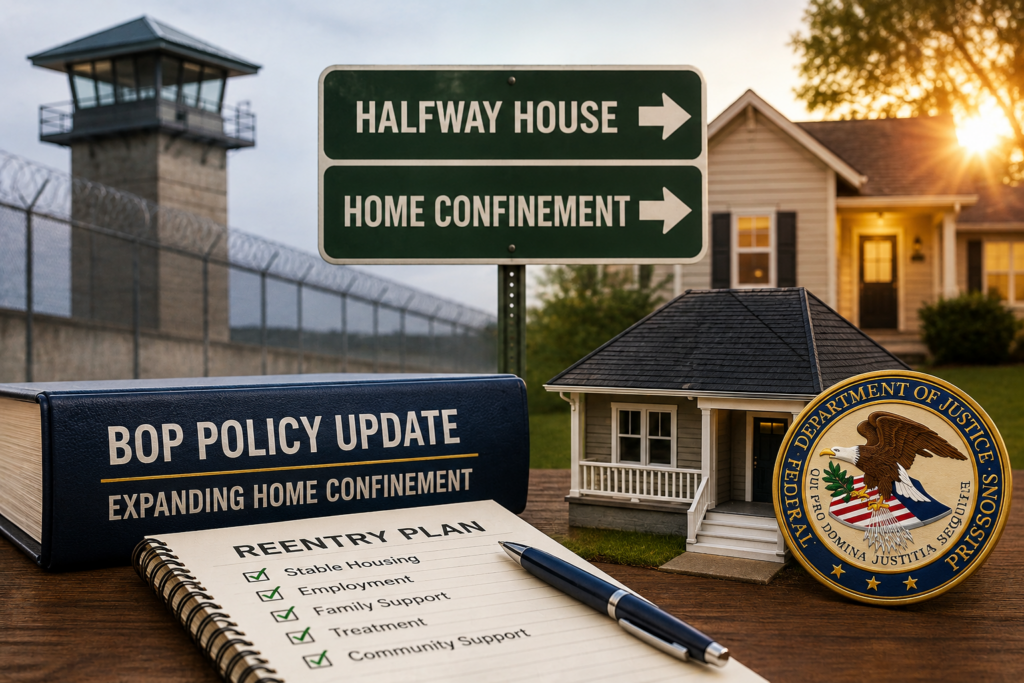
Federal Prison Release Planning
BOP Home Confinement Changes: Can Federal Prisoners Skip the Halfway House?
For years, many federal prisoners were told the same thing: first prison, then halfway house, then maybe home confinement. New BOP guidance suggests that path may be changing for eligible prisoners with strong release plans, stable housing, and properly calculated First Step Act credits.
The Bureau of Prisons is shifting how it talks about home confinement. Recent BOP directives tell staff to expand the use of home confinement for eligible individuals under the First Step Act and Second Chance Act, prioritize home confinement for people who do not need Residential Reentry Center services, and use Conditional Placement Dates to drive timely referrals.
That may sound technical. For federal prisoners and families, it can be life-changing.
The old model treated the halfway house as the default stop before home. The new guidance suggests that, in some cases, the halfway house should not be automatic. If a person is statutorily eligible, has a stable home, has strong community support, has earned First Step Act credits, and does not need the structured services of a Residential Reentry Center, direct home confinement may be appropriate.
The question is no longer just, “When is my loved one going to the halfway house?”
The better question may be: “Should the BOP be considering direct home confinement instead?”
What Changed With BOP Home Confinement Guidance?
The BOP has issued guidance emphasizing expanded use of home confinement under both the First Step Act and the Second Chance Act. The guidance makes several points that families should understand:
- Home confinement is a priority for eligible people who do not require the structured support of a Residential Reentry Center.
- Residential Reentry Center placement should be reserved for those with the greatest need for transitional services.
- Conditional Placement Dates matter because they help guide timely prerelease planning.
- First Step Act credits and Second Chance Act eligibility may work together instead of being treated as separate barriers.
- Stable housing and reentry readiness matter when deciding whether home confinement is appropriate.
- RRC bed limitations should not block home confinement when a person is statutorily eligible and appropriate for placement.
This is a major development because many families have watched loved ones sit in federal prison waiting for halfway house space even when the person had a safe home, a support system, and no real need for a halfway house bed.
What Is Home Confinement?
Home confinement allows an eligible federal prisoner to serve part of the sentence at home under supervision instead of inside a federal prison or halfway house. It is not freedom without rules. People on home confinement may be subject to monitoring, movement restrictions, employment requirements, check-ins, drug testing, location monitoring, and other conditions.
But for families, home confinement can mean the person is back in the community, sleeping at home, rebuilding relationships, working, supporting children, caring for loved ones, and preparing for supervised release.
That is why home confinement decisions matter. A person may still be serving a sentence, but the difference between a prison unit and a stable home environment is enormous.
What Is a Residential Reentry Center?
A Residential Reentry Center, often called an RRC or halfway house, is a contracted community facility used to help people transition from prison back into society. Halfway houses can provide structure, employment assistance, monitoring, drug testing, accountability, and reentry support.
For some people, that structure is necessary. For others, it may not be. A person with stable housing, strong family support, a job offer, clean conduct, completed programming, and a good release plan may not need the same halfway house services as someone with no housing, no employment path, no support system, or serious reentry barriers.
The new BOP guidance recognizes that distinction. The halfway house should not be treated as a one-size-fits-all requirement.
Can a Federal Prisoner Skip the Halfway House?
In some cases, yes. The better way to say it is this: eligible federal prisoners may be considered for direct home confinement when the law, BOP guidance, release plan, and individual facts support it.
That does not mean everyone can skip the halfway house. It does not mean the BOP must send every eligible person directly home. It does mean families should stop assuming the halfway house is always required before home confinement.
A strong direct-home-confinement case may include:
- Minimum or low PATTERN risk level;
- Strong First Step Act credit history;
- Clean or limited disciplinary record;
- Stable housing confirmed in writing;
- Supportive family or community network;
- Employment, retirement, disability, education, or other lawful plan;
- No unresolved detainers or immigration barriers;
- No serious institutional conduct problems;
- No need for intensive halfway house services;
- A clear release plan that can be verified.
Prison Law Firm takeaway: Direct home confinement is not automatic. But if your loved one has earned credits, has stable housing, and does not need RRC services, the file should clearly explain why home confinement is appropriate.
First Step Act Credits and Home Confinement
The First Step Act allows eligible federal prisoners to earn time credits through Evidence-Based Recidivism Reduction Programs and Productive Activities. These credits may be applied toward prerelease custody or supervised release when the statutory requirements are satisfied.
Prisoners and families often focus only on the number of credits earned. That is important, but it is not the whole picture. The BOP also looks at eligibility, risk level, disciplinary history, release planning, detainers, and whether the person is appropriate for community placement.
That means a person can have credits on paper but still need help making sure the credits are properly calculated, properly applied, and connected to an actual release plan.
Related reading: First Step Act Time Credit Calculator and 130+ First Step Act Programs That Earn Federal Prison Time Credits.
Second Chance Act Placement Still Matters
The Second Chance Act gives the BOP authority to place eligible people in prerelease custody, including RRC placement and home confinement, near the end of the sentence. For years, families often thought of Second Chance Act placement as the ordinary halfway house process.
The newer guidance is important because it tells staff to treat First Step Act credits and Second Chance Act eligibility as cumulative and stackable where appropriate. In plain English, the BOP should not use one law as an excuse to ignore the other.
For some prisoners, First Step Act credits may move the prerelease timeline forward. For others, Second Chance Act placement may create an additional pathway to community custody. For the best-prepared cases, both may support a stronger argument for earlier home confinement.
What Is a Conditional Placement Date?
A Conditional Placement Date is a planning date used by the BOP to help determine when a person may be referred for prerelease custody based on projected credits and statutory timelines. It is not the same thing as a guaranteed release date, but it can be extremely important.
When the Conditional Placement Date is wrong, late, ignored, or misunderstood, the person may lose valuable time. A delayed referral can mean delayed home confinement, delayed halfway house placement, or unnecessary time in prison.
Families should ask whether the BOP has correctly calculated:
- The projected release date;
- Good Conduct Time;
- Earned First Step Act credits;
- Projected future FSA credits;
- Second Chance Act eligibility;
- Home confinement eligibility;
- Conditional Placement Date;
- RRC referral date;
- Home confinement review date.
The Release Plan Is Now More Important Than Ever
If home confinement is going to be based on stable housing, support systems, and readiness for reintegration, then the release plan is not just paperwork. It is evidence.
A weak release plan says, “He can live with family.”
A strong release plan proves:
- Where the person will live;
- Who owns or leases the home;
- Who else lives there;
- Whether the home is suitable for monitoring;
- How the person will support themselves;
- Whether employment is available;
- How transportation will be handled;
- What medical care, counseling, or treatment is needed;
- How family support will work;
- Why the person does not need RRC services.
In a direct home confinement request, the release plan should be organized, specific, and easy for staff to verify. Do not make the BOP guess. Make the file clear.
Who May Be a Good Candidate for Direct Home Confinement?
Every case is different, but some people may have stronger arguments than others. A good candidate may be someone who:
- Has a minimum or low recidivism risk score;
- Has completed significant First Step Act programming;
- Has earned substantial FSA credits;
- Has no recent disciplinary problems;
- Has stable verified housing;
- Has a job offer or reliable financial support;
- Has strong family ties;
- Has medical or family circumstances better managed at home;
- Does not need intensive reentry services from an RRC;
- Can comply with location monitoring and supervision.
The strongest cases do not just say the person deserves home confinement. They prove the person is ready for it.
What Families Should Gather Now
If your loved one may be eligible for home confinement, start gathering documents early. Waiting until the last few weeks can create unnecessary delay.
Helpful records may include:
- Judgment and commitment order;
- Current projected release date;
- FSA credit calculation sheet;
- Program completion certificates;
- Work assignment records;
- Disciplinary history;
- PATTERN risk level information;
- Medical records, if relevant;
- Housing confirmation letter;
- Employment offer or income-support documentation;
- Family support letters;
- Transportation plan;
- Treatment, counseling, or medical-care plan;
- Any prior RRC or home-confinement referral paperwork.
Families should also keep track of what the unit team says. If the BOP denies, delays, or ignores a home-confinement request, those communications may matter later.
When Should a Bad Home Confinement Decision Be Challenged?
Not every disappointing decision is legally wrong. The BOP has discretion in many placement decisions. But some problems deserve closer review.
Potential red flags include:
- The BOP refuses to consider home confinement at all;
- Staff says everyone must go to the halfway house first;
- FSA credits appear missing or miscalculated;
- The Conditional Placement Date seems wrong;
- The person is eligible but no referral is made;
- RRC bed space is treated as a reason to keep someone in prison;
- Stable housing is ignored;
- The release plan was never reviewed;
- The denial is based on outdated or incorrect information.
Depending on the issue, the next step may be a request to the unit team, a written release-plan supplement, an administrative remedy, a sentence-calculation review, or other legal action.
How Prison Law Firm Can Help
Prison Law Firm helps federal prisoners, families, and attorneys review BOP release planning issues, First Step Act credits, sentence calculations, halfway house referrals, home confinement eligibility, and administrative remedy strategy.
For home confinement issues, we can help review:
- Whether First Step Act credits are properly calculated;
- Whether the prisoner may qualify for home confinement;
- Whether the Conditional Placement Date appears accurate;
- Whether the release plan is strong enough;
- Whether RRC placement is actually necessary;
- Whether BOP staff are applying outdated assumptions;
- Whether an administrative remedy should be filed;
- Whether the family should supplement the record before a decision is made.
Do Not Wait Until the Release Date Is Close
Home confinement decisions depend on records, credits, timing, eligibility, and release planning. If your loved one may be eligible, the file should be organized before the BOP makes the referral decision.
Bottom Line
The BOP’s new home confinement guidance creates an important opportunity for eligible federal prisoners. The halfway house may still be necessary for many people. But it should not be treated as an automatic stop when the person is eligible, prepared, stable, and ready for direct home confinement.
For families, the lesson is simple: release planning now matters more than ever.
If the First Step Act credits are wrong, the Conditional Placement Date is wrong, the release plan is weak, or the BOP assumes the person must go to the halfway house first, valuable time can be lost.
Direct home confinement is not guaranteed. But for the right person with the right record, it may be a real path home.
Sources
Frequently Asked Questions About BOP Home Confinement
Can a federal prisoner go straight to home confinement instead of a halfway house?
In some cases, yes. Eligible prisoners with stable housing, strong reentry plans, properly calculated First Step Act credits, and no need for Residential Reentry Center services may have an argument for direct home confinement.
Does BOP have to grant home confinement?
No. Home confinement is not automatic. The BOP considers statutory eligibility, public safety, risk level, housing, release readiness, conduct, and other factors. But the BOP should not rely on outdated assumptions or refuse to consider home confinement when the law and facts support it.
What is a Conditional Placement Date?
A Conditional Placement Date is a planning date used by the BOP to guide prerelease custody referrals based on projected credits and statutory timelines. It is not always a guaranteed release date, but it can be important for timely home confinement or halfway house review.
Do First Step Act credits help with home confinement?
Yes. First Step Act earned time credits may support earlier prerelease custody, including home confinement, when the prisoner is eligible and the credits are properly calculated and applied.
What makes a strong home confinement release plan?
A strong release plan identifies verified housing, household members, employment or financial support, transportation, medical care, treatment needs, family support, and why the person can safely transition home without needing a halfway house placement.
Can Prison Law Firm help challenge a home confinement delay?
Yes. Prison Law Firm can help review First Step Act credits, release planning, Conditional Placement Dates, home confinement eligibility, halfway house referrals, and whether an administrative remedy or other action may be appropriate.