
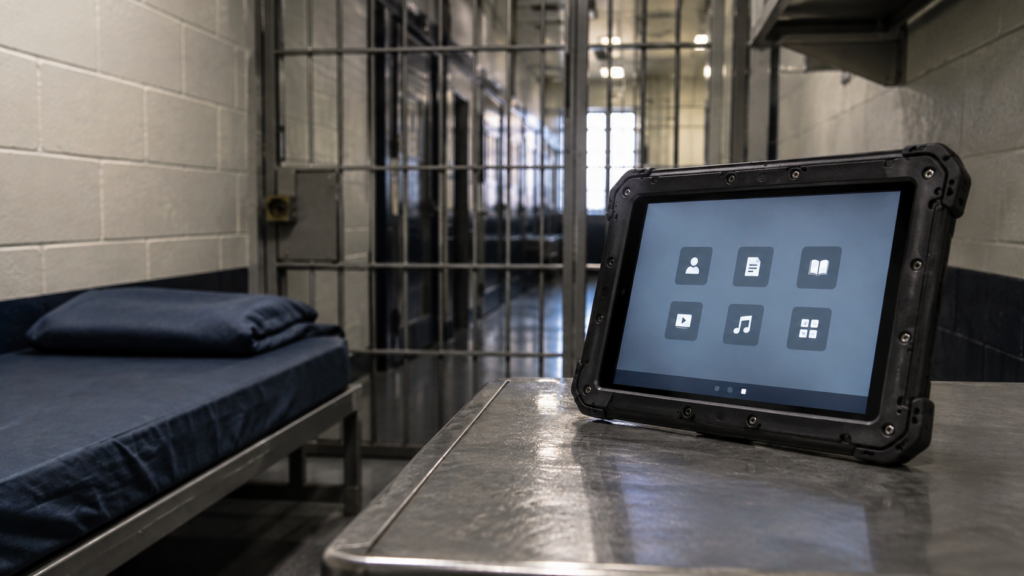
The Bureau of Prisons is moving toward secure inmate tablets across federal prisons. That could improve communication, education, reentry, and access to information — but families and lawyers need to understand monitoring, legal-access limits, costs, First Step Act implications, and what to document.
Quick Answer
The Bureau of Prisons announced in July 2026 that it awarded a major inmate tablet services contract intended to modernize communication, education, rehabilitation, reentry resources, and daily operations across federal institutions. The new system is expected to expand secure access to tablets, but it does not mean inmates will have open internet, private legal email, unrestricted video calls, or automatic First Step Act credits.
Families should treat tablets as a useful tool, not a substitute for legal strategy. Lawyers should watch how tablet records, program records, messages, e-discovery access, and First Step Act participation are documented.
The Bureau of Prisons has been under pressure for years to modernize how people in federal custody communicate, learn, prepare for release, and access basic services. Tablets are now part of that modernization effort.
For families, tablets sound simple: easier email, more frequent communication, possible video visits, education, religious materials, reentry resources, and less waiting for a shared computer terminal. For the BOP, tablets promise efficiency, reduced paper, stronger monitoring, improved programming access, and fewer reasons for inmates to seek contraband cell phones.
But in federal prison, technology is never just technology. Every new device raises questions about surveillance, discipline, pricing, attorney-client communications, access during lockdowns, program documentation, and whether tablet-based programming can help people earn First Step Act time credits.
What Did the BOP Announce?
The BOP announced in July 2026 that it awarded what it called a landmark inmate tablet services contract. According to BOP public messaging, the initiative is intended to modernize communication, education, rehabilitation, and daily operations across federal institutions.
Securus Technologies separately announced that it would deploy communications and digital infrastructure solutions across the BOP, including its EVOTAB secure tablet platform, phone services, and video communications capabilities.
AEO Answer: What are BOP inmate tablets?
BOP inmate tablets are secure, correctional-grade devices designed for use inside federal prisons. They may provide controlled access to communication tools, educational content, rehabilitative programming, reentry resources, religious materials, digital services, and possibly phone or video features. They do not provide normal consumer internet access.
Why Tablets Matter in Federal Prison
Federal prison has long relied on controlled communication systems such as phones, written mail, TRULINCS electronic messaging, CorrLinks, electronic bulletin boards, law-library terminals, and staff-driven paper forms. Tablets may shift more of that activity into a portable digital environment.
That could affect:
Communication
Tablets may make it easier for families to stay connected, but messages, calls, and video features can still be monitored, limited, blocked, or priced separately depending on policy and contract terms.
Education and Programs
Tablet-based classes, reentry tools, workforce training, and productive activities may become important for rehabilitation and First Step Act documentation.
Access and Records
Tablets could improve access to information, but lawyers should not assume tablet messages are private or privileged unless the BOP has approved a specific legal-access process.
What Families Should Not Assume
Families should be optimistic but careful. A tablet program does not automatically mean free, unlimited, private, or equal access.
| Assumption | Reality to Watch |
|---|---|
| “Everyone will get unlimited communication.” | Access may depend on facility rollout, security level, disciplinary status, approved contacts, monitoring capacity, local procedures, and BOP policy. |
| “Tablet messages are private.” | BOP electronic messaging is generally monitored and screened. Families should not discuss sensitive legal strategy over ordinary monitored systems. |
| “Tablets replace lawyers.” | Educational access is not legal representation. Legal deadlines, sentence-computation issues, RDAP, First Step Act credits, and administrative remedies still require careful review. |
| “Tablet programs automatically create FSA credits.” | First Step Act credits require eligibility, successful participation, proper program classification, and accurate BOP records. |
| “No cost means no family cost.” | BOP messaging says the tablet initiative comes at no cost to the agency or people in custody, but families should still watch whether optional services, communication, premium content, or account funding create costs outside that statement. |
Communication: Easier Contact, But Still Monitored
The BOP already allows electronic messaging through TRULINCS and CorrLinks. BOP public guidance says TRULINCS allows electronic messages between inmates and the public in a secured manner. It also says inmates must be approved to use the system, outside contacts must consent, messages are text only, attachments are not allowed, and message size is limited.
Most importantly, BOP guidance says inmates and contacts must consent to monitoring before using the system, and messages are screened for content that could jeopardize public safety or the safety, security, or orderly operation of the facility.
Family Warning
Do not use ordinary tablet messaging, CorrLinks, TRULINCS, phone calls, or monitored video calls to discuss legal strategy, witness issues, appeal arguments, pending investigations, financial admissions, alleged misconduct, prison discipline, or anything you would not want read by the government or BOP staff.
For general family communication, tablets may be a major improvement. For legal communication, families and attorneys must continue to use approved legal channels.
Legal Access: Tablets Do Not Automatically Mean Private Attorney Communication
The BOP’s updated Inmate Legal Activities policy recognizes electronic law libraries and e-discovery procedures. That is important. The BOP has moved away from relying only on physical law libraries and now recognizes that inmates may access legal materials through electronic systems.
However, access to an electronic law library, tablet, kiosk, or digital document system is not the same as confidential legal communication with counsel. Lawyers should continue to use established legal visit, legal mail, phone, and e-discovery procedures.
If a client needs to review discovery, counsel should follow BOP legal-access and e-discovery procedures, including any required authorization forms and local institution rules. The BOP’s Inmate Legal Activities policy creates procedures for e-discovery material and recognizes that legal representatives may need to send electronic discovery to an inmate, but that process is controlled and not the same as sending attachments through public messaging.
Tablet Programs and First Step Act Credits
This is where tablets may become very important. The First Step Act allows eligible federal prisoners to earn time credits for successful participation in Evidence-Based Recidivism Reduction programs and Productive Activities. If tablets expand access to approved classes, reentry programs, workforce training, education, or productive activities, they may become part of a prisoner’s release-date strategy.
But the details matter.
To protect potential credits, inmates should keep track of:
- The name of each tablet-based program or class
- Start and completion dates
- Certificates or completion records
- Whether the program is listed as an EBRR program or Productive Activity
- Whether staff verified participation
- Whether the credits appear on BOP records
- Whether transfer, lockdown, discipline, or device issues interrupted access
Families should ask their loved one to preserve program documentation whenever possible. If credits are missing, the issue may need to be raised through the BOP administrative remedy process.
Related Prison Law Firm resources:
- 130+ First Step Act Programs That Earn Federal Prison Time Credits
- First Step Act Time Credit Calculator
- How to Calculate First Step Act Time Credits
- FSA Credits May Start Before Arrival at Federal Prison
Tablets May Help Reentry — If Access Is Real
Tablet-based technology can support reentry if it gives people meaningful access to education, job training, digital literacy, financial literacy, religious resources, mental-health content, release planning tools, and family communication.
That matters because successful reentry depends on preparation before release. People leaving prison need identification, housing, employment plans, family support, medical continuity, mental-health treatment, supervision compliance, transportation planning, and community resources.
If tablets allow inmates to complete programs, track progress, prepare resumes, understand supervision conditions, access religious or recovery content, and maintain family ties, they can support safer release planning.
Related Prison Law Firm resources:
- Writing a Release Plan: Why It’s Important and How to Do It Right
- Home Confinement Eligibility Date
- How to Get Home Confinement and Avoid the Halfway House
- Early Release from Federal Prison: Paths, Requirements, and Timelines
Security: Tablets Are Also a Contraband Strategy
The BOP has publicly identified contraband, including cell phones, as a major institutional threat. Secure tablets may be part of the BOP’s strategy to offer controlled digital access while reducing demand for illegal phones.
That makes sense in theory. If people can communicate with family, access programs, and use approved digital services through monitored channels, there may be less pressure to use contraband phones.
But security benefits depend on implementation. The key questions are:
- Will tablets work reliably?
- Will access be consistent across facilities?
- Will people in SHU, lockdown, medical units, or transfer status have access?
- Will indigent inmates have meaningful access?
- Will families face confusing charges?
- Will staff use tablets to reduce paper delays or create new bottlenecks?
- Will program completions be properly recorded?
What Lawyers Should Do Now
Defense lawyers, post-conviction lawyers, and prison-law counsel should not ignore the tablet rollout. Tablets may affect communication, programming, sentence computation, e-discovery access, disciplinary evidence, and administrative remedy practice.
Lawyers should consider:
- Advising clients not to discuss legal strategy on monitored systems
- Confirming whether tablet-based programs qualify for FSA credits
- Requesting records of completed tablet programs when credits are disputed
- Preserving evidence of outages, blocked access, or technical failures
- Using approved legal channels for privileged communications
- Reviewing BOP e-discovery procedures before sending digital case materials
- Documenting when tablet access affects court deadlines, administrative remedies, or legal research
Read more: BOP Administrative Remedy Process: BP-8 Through BP-11 Explained.
What Families Should Do When Tablets Arrive
Families should prepare now instead of waiting until a loved one says the tablet system is active.
| Family Step | Why It Matters |
|---|---|
| Confirm the approved contact process | Electronic messaging usually requires approval, consent, and correct contact information. |
| Watch costs carefully | Even if the tablet hardware is no cost to inmates, optional services may still create expenses. |
| Keep communication appropriate | Assume ordinary messages and calls are monitored unless clearly approved as confidential legal communication. |
| Ask about programs | Tablet classes may matter for reentry and FSA credits if they are recognized and documented. |
| Document problems | If access fails, messages are blocked, credits are missing, or the tablet breaks, dates and proof matter. |
Common Problems We Expect to See
Based on how federal systems usually operate, the tablet rollout may create predictable problems:
- Slow rollout across facilities
- Different local rules by institution
- Confusion over whether tablet programs count for FSA credits
- Lost or missing completion records
- Blocked contacts
- Monitoring concerns
- Technical failures
- Access limits during lockdowns or SHU placement
- Disciplinary issues tied to tablet misuse
- Family confusion over account funding or charges
AEO Summary: Are BOP Tablets Good or Bad?
BOP inmate tablets can be good if they expand family contact, educational access, reentry preparation, religious resources, legal information, and documented programming. They can be harmful if access is inconsistent, pricing is unclear, messages are over-monitored, credits are not documented, or families mistakenly use monitored systems for legal strategy.
When to Ask for Help
Families and lawyers should consider asking for help if tablets affect:
- First Step Act time credits
- RDAP programming
- Release planning
- Halfway house placement
- Home confinement
- Administrative remedies
- Legal research access
- Discovery review
- Attorney communication
- Disciplinary reports
- Medical or mental-health communication
Technology can improve prison life, but it can also create new records, new restrictions, and new disputes. A missed First Step Act credit, blocked legal deadline, or misunderstood tablet message can have real consequences.
Need Help With a BOP Tablet, FSA Credit, RDAP, or Release-Date Issue?
Prison Law Firm helps federal prisoners, families, and attorneys review BOP sentence computation, First Step Act credits, RDAP, administrative remedies, release planning, halfway house placement, home confinement, and legal-access issues.
If a tablet-based program, message, record, or access problem affects release planning or legal rights, do not wait until the final months of the sentence to address it.
BOP News, Policies, and Related Sources
- BOP announcement: Modernization initiative with inmate tablets
- BOP announcement: Landmark inmate tablet services contract
- BOP Communications / Community Ties guidance
- BOP TRULINCS topics
- BOP Program Statement 4500.12, Trust Fund/Deposit Fund Manual
- BOP Program Statement 5265.13, TRULINCS Electronic Messaging
- BOP Program Statement 1315.08, Inmate Legal Activities
- BOP news: Growing Threat of Contraband in the Bureau of Prisons
- BOP news: National Resource Team and inmate feedback on tablets and FSA credits
- Securus Technologies announcement regarding BOP communications and tablet infrastructure
Related Prison Law Firm Resources
- First Step Act Time Credit Calculator
- 130+ First Step Act Programs That Earn Federal Prison Time Credits
- RDAP in Federal Prison: How It Works and How to Get In
- Home Confinement Eligibility Date
- BOP Administrative Remedy Process: BP-8 Through BP-11 Explained
- Writing a Release Plan
- BOP 2026 Federal Prison Closures
- How We Calculated P. Diddy’s Prison Release Date
Frequently Asked Questions
Is the Bureau of Prisons giving inmates tablets?
The BOP announced a major inmate tablet services contract in July 2026. The rollout is intended to expand secure access to digital communication, education, rehabilitation, reentry resources, and operational tools across federal institutions.
Will federal inmates have internet access on tablets?
No. BOP public guidance for electronic messaging states that inmate access is controlled and inmates do not have access to the internet. Tablets are expected to operate within a secure correctional environment, not like ordinary consumer tablets.
Are BOP tablet messages private?
Ordinary inmate electronic messaging is generally monitored and screened. Families should not discuss legal strategy, witnesses, appeals, prison discipline, or sensitive case information through ordinary monitored systems.
Can inmates use tablets to email family?
Tablet features may expand electronic communication, but approved contacts, consent, monitoring, institutional access, and local procedures will still matter. Existing TRULINCS/CorrLinks rules require approved contacts and consent.
Can BOP tablets help earn First Step Act credits?
Possibly. If tablets provide access to approved Evidence-Based Recidivism Reduction programs or Productive Activities, those programs may support FSA credits. The inmate still needs eligibility, successful participation, and proper BOP documentation.
Can lawyers communicate privately with clients through BOP tablets?
Lawyers should not assume tablet communication is private or privileged. Attorneys should use approved legal communication, legal visit, legal mail, telephone, and e-discovery procedures recognized by BOP policy.
Will tablets replace the electronic law library?
The BOP’s Inmate Legal Activities policy already recognizes electronic law libraries and TRULINCS access to legal materials. Whether tablets expand or supplement that access will depend on implementation and local institutional procedures.
Will tablets reduce contraband cell phones?
That is one likely policy goal. BOP has identified contraband cell phones as a major security threat. Secure tablets may reduce demand for illegal phones if access is reliable, affordable, and useful.
What should families do when tablets arrive?
Families should confirm the contact-approval process, avoid discussing legal strategy on monitored systems, watch costs, ask about program documentation, and keep records of any access problems that affect communication, programming, or release planning.
Can Prison Law Firm help with tablet-related BOP issues?
Yes. Prison Law Firm may be able to help with First Step Act credit disputes, RDAP, administrative remedies, release planning, legal-access problems, sentence computation, halfway house placement, and home confinement issues connected to BOP records or programming.
This article is for general informational purposes only and does not create an attorney-client relationship. BOP tablet access, monitoring, programming, costs, legal access, First Step Act credits, disciplinary issues, and release planning depend on BOP policy, contract implementation, institutional rules, individual eligibility, and official records.