
Federal Prison Consulting Update
Quick Answer
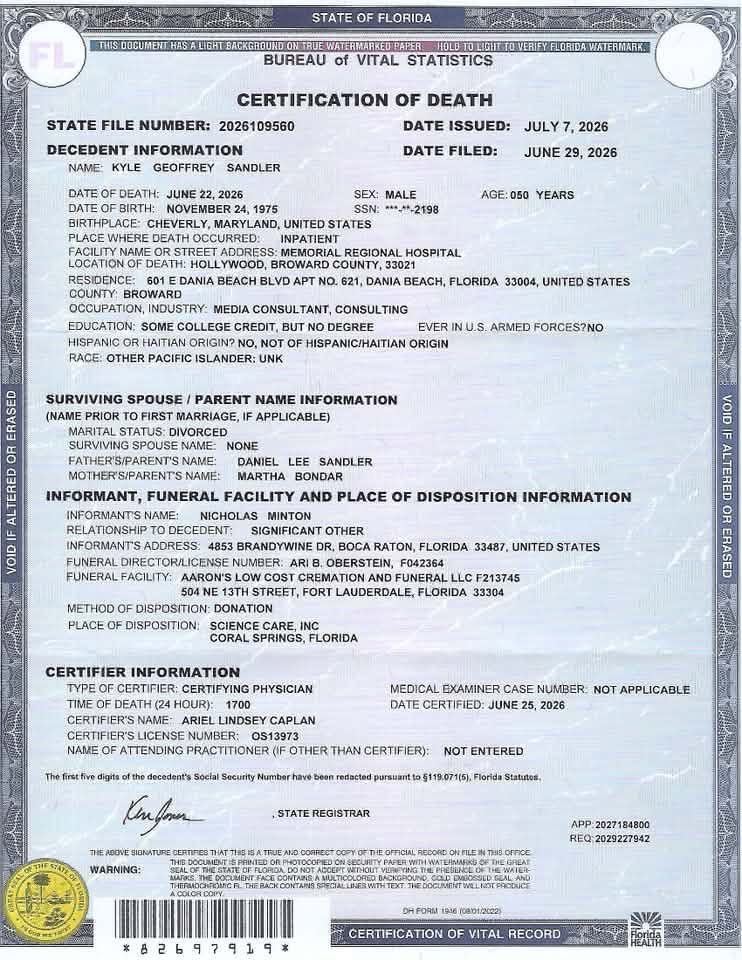
A Florida Certificate of Death confirms that Kyle Geoffrey Sandler died on June 22, 2026. For former Federal Prison Tips clients, the most important step now is not speculation. It is documentation. If you paid Federal Prison Tips for federal prison consulting, BOP assistance, RDAP help, First Step Act work, compassionate release support, supervised release work, or any other service, preserve your records, verify whether the work was completed, identify any deadlines, and consider using the death certificate as supporting documentation if you request a refund, file a payment dispute, or seek information about unfinished services.
Update: Death Confirmed by Official Florida Death Certificate
Prison Law Firm has reviewed a Florida Certificate of Death for Kyle Geoffrey Sandler. The certificate identifies Sandler as having died on June 22, 2026, in Broward County, Florida. The certificate was filed on June 29, 2026, and issued on July 7, 2026.
This article is no longer treating the matter as an unconfirmed public report. The death certificate confirms the death. Prison Law Firm is not making a medical finding about the cause of death, the circumstances of the final hospitalization, or any possible relationship between prior injuries and the death.
The human side of this story should not be ignored. A sudden death is tragic for any family, and Prison Law Firm extends sympathy to those grieving that loss.
But compassion and caution can exist at the same time. The death of a business owner does not automatically resolve unfinished client work, missed deadlines, payment disputes, refund requests, or questions about whether promised federal prison consulting services were actually completed.
Why This Matters for Former Federal Prison Tips Clients
Federal Prison Tips was one of the most visible prison consulting brands online. Its content reached defendants facing federal charges, people preparing for sentencing, incarcerated individuals, and families trying to understand the Bureau of Prisons.
Some people viewed Sandler as someone who had been through the federal system and was using that experience to educate others. Others contacted Prison Law Firm with concerns about unresponsiveness after payment, confusion over court filings, delays, unfinished work, or uncertainty over whether promised services had been completed.
Those are client reports, not findings by a court. Still, when families facing federal prison pay for help, communication and follow-through matter.
If Federal Prison Tips has ceased operations and there is no functioning administrative staff, former clients may have no clear way to obtain files, confirm work, request updates, or address payments. That makes independent verification even more important.
Important Client Takeaway
Do not assume that a shutdown announcement, a referral to another company, or the death of a business owner resolves your matter.
If you paid for work connected to a federal prison issue, court filing, BOP request, RDAP review, First Step Act credit issue, compassionate release matter, supervised release issue, administrative remedy, disciplinary appeal, or sentence calculation concern, verify the status yourself.
Use the Death Certificate When Requesting a Refund or Payment Review
If you paid Federal Prison Tips and did not receive the services you purchased, the Florida death certificate may be useful supporting documentation when requesting a refund, contacting a bank or credit card company, filing a payment dispute, contacting a payment processor, speaking with consumer protection officials, or asking a probate representative about unfinished business obligations.
Keep the request factual. State what you purchased, when you paid, how much you paid, what was promised, what was delivered, what remains unfinished, and why the death of the business owner affects the ability to complete the work.
When sharing a death certificate, avoid sending unnecessary personal information to anyone who does not need it. If you are submitting it to a bank, credit card company, payment processor, attorney, probate court, or consumer protection agency, ask what documentation they require and whether sensitive information should be redacted.
What Affected Clients Should Do Now
1. Preserve Every Document and Message
Download and save everything connected to Federal Prison Tips. This includes contracts, invoices, receipts, payment confirmations, emails, text messages, direct messages, screenshots, intake forms, drafts, promised deliverables, and any communication describing what the company agreed to do.
Do not assume that a website, portal, social media account, email inbox, phone number, or payment page will remain available.
2. Confirm Whether Work Was Actually Completed
If Federal Prison Tips was supposed to prepare, submit, or help with anything, verify it independently. This may include a sentencing memorandum, designation packet, RDAP review, First Step Act request, administrative remedy, compassionate release request, 3582 motion, 2255 motion, supervised release filing, medical request, disciplinary appeal, or other document.
For court filings, check PACER, contact the clerk’s office, or ask the attorney of record. For Bureau of Prisons issues, review available BOP records, administrative remedy history, sentence computation information, and any written response from BOP staff.
Do not rely on the idea that something was “being prepared.” Confirm whether it was submitted and received.
3. Identify Any Deadlines
Federal prison and post-conviction matters can involve strict deadlines. A missed administrative remedy appeal, disciplinary appeal, compassionate release exhaustion issue, sentence computation challenge, supervised release issue, appeal deadline, or 28 U.S.C. § 2255 deadline can create serious problems.
If you paid for work connected to a deadline, have the timeline reviewed immediately.
4. Do Not Assume a “No Refunds” Statement Ends Your Rights
A company’s inability or unwillingness to process refunds does not necessarily determine a client’s rights. Depending on how payment was made, clients may still be able to contact a bank, credit card company, payment processor, consumer protection agency, probate representative, or attorney.
Keep the dispute factual. Include the payment record, engagement agreement, messages, deliverables, and, where appropriate, the death certificate confirming that the business owner is deceased.
5. Be Careful With Any Referral or Handoff
Families should not assume that any third party automatically has their file, authority to act, responsibility for prior payments, or the ability to fix unfinished work.
Before hiring anyone else, ask direct questions:
- Are you a lawyer, consultant, advocate, or document preparer?
- Do you have my complete file?
- Who gave you permission to receive my information?
- Will I be charged again?
- What exact work will you perform?
- What deadlines apply?
- Will anything be filed with a court or the Bureau of Prisons?
- Who is responsible for services I already paid for but did not receive?
- Will you provide a written engagement agreement?
Federal Prison Consulting Is Not the Same as Legal Representation
Some consultants provide useful education and practical guidance. But federal prison consulting is not the same as legal representation.
That distinction matters. Families sometimes believe they are paying for legal help, court filings, sentence reductions, BOP advocacy, or guaranteed outcomes. In reality, many prison consultants are not law firms and cannot represent clients in court.
Before paying any prison consultant, families should understand exactly what is being offered, who is doing the work, whether an attorney is involved, whether court filings are included, whether legal advice is being provided, and whether the person or company is qualified to handle the issue.
Common Issues Former Federal Prison Tips Clients May Need Reviewed
If you were working with Federal Prison Tips, the right next step depends on what you paid for and what remains unresolved. Prison Law Firm can help review federal prison and post-sentencing issues involving:
- Federal prison designation and transfer issues
- First Step Act time credits
- RDAP eligibility and documentation
- Halfway house and home confinement placement
- Sentence computation concerns
- Administrative remedies
- Medical care and compassionate release issues
- Disciplinary proceedings
- Supervised release questions
- Review of prior consultant work product
- Determining whether a promised filing appears to have been submitted
- Identifying payment records for possible refund or dispute requests
If You Paid Federal Prison Tips, Do Not Wait in the Dark
If you or your loved one paid Federal Prison Tips and now do not know whether the work was completed, Prison Law Firm can help review the situation.
We can help determine what appears to have been done, what still needs attention, whether any prison, court, or deadline-related issue requires immediate action, and what records may be useful if you are seeking a refund or payment review.
A Sympathetic But Serious Moment
The death confirmed by the Florida death certificate is tragic. Sympathy for Sandler’s family and loved ones is appropriate.
But sympathy does not erase the concerns of clients who paid for services, expected work to be completed, or may now be facing uncertainty about court filings, BOP matters, refunds, deadlines, or their own legal rights.
Families impacted by the federal prison system deserve clear answers. They deserve their files. They deserve to know what was done, what was not done, and what options remain.
That is where the focus should be now.
Frequently Asked Questions
Is Kyle Sandler dead?
Yes. A Florida Certificate of Death confirms that Kyle Geoffrey Sandler died on June 22, 2026, in Broward County, Florida.
Does the death certificate state the cause of death?
The certificate reviewed by Prison Law Firm confirms the death but does not provide a public medical finding by Prison Law Firm about the cause of death or the circumstances of the final hospitalization.
What should I do if I paid Federal Prison Tips for services?
Save all records, including invoices, receipts, emails, text messages, contracts, payment confirmations, screenshots, drafts, and promised deliverables. Then verify whether the work you paid for was actually completed.
Can I use the death certificate when requesting a refund?
Yes. If you are requesting a refund, disputing a payment, contacting a bank or credit card company, or asking a payment processor to review the charge, the death certificate may be useful supporting documentation showing that the business owner is deceased. Ask the recipient what documentation they require and whether sensitive information should be redacted.
What if Federal Prison Tips was supposed to file something for me?
Check the federal court docket, contact the clerk’s office, ask the attorney of record, or have a qualified professional review the matter. Do not assume a filing was submitted unless you can confirm it.
Can I still dispute a payment or request a refund?
Possibly. A company’s shutdown, lack of administrative capacity, or death of a business owner does not necessarily eliminate a client’s rights. Contact your bank, credit card company, payment processor, consumer protection agency, probate representative, or legal counsel to understand your options.
Should I hire another company recommended after the shutdown?
Do your own due diligence before hiring anyone. Ask whether they are lawyers or consultants, whether they have your file, whether you will be charged again, what work they will perform, whether any deadlines apply, and whether they will provide a written agreement.
Can Prison Law Firm help if I was a Federal Prison Tips client?
Yes. Prison Law Firm can review the situation, determine what work appears to have been completed, identify unresolved federal prison issues, and help evaluate possible next steps.
Is this article accusing Federal Prison Tips of fraud?
No. This article does not make a legal finding of fraud regarding Federal Prison Tips. It addresses the death confirmed by a Florida death certificate, client concerns reported to Prison Law Firm, and practical steps affected clients may want to consider.
Important Disclaimer
This article is for general informational purposes only and does not create an attorney-client relationship. Every case is different. If you believe a deadline may apply to your case or your loved one’s case, seek case-specific guidance immediately.