
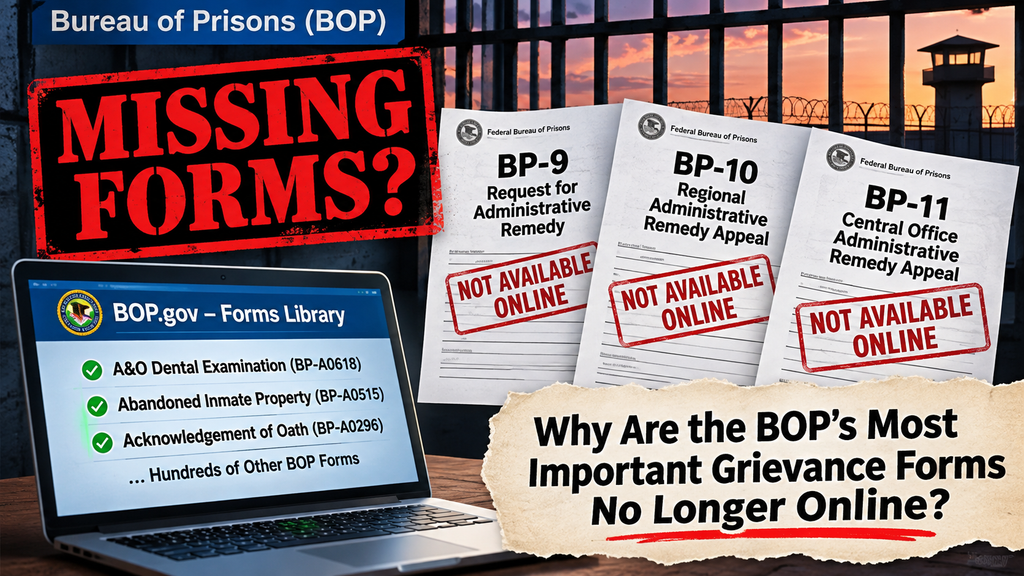
Federal prisoners are required to use the Bureau of Prisons Administrative Remedy Program when they want the BOP to correct many problems involving their confinement. Yet some of the most important forms in that process—the BP-9, BP-10 and BP-11—are not available in the BOP’s public online forms library.
That is difficult to understand in 2026.
The Federal Bureau of Prisons maintains an extensive online library containing hundreds of downloadable forms. Prisoners, families, attorneys and members of the public can find forms dealing with everything from dental examinations to abandoned inmate property.
But try to find the forms a federal prisoner needs to formally challenge a BOP decision.
You may have a much harder time.
The BOP Publishes Hundreds of Other Forms Online
The contrast is striking.
Visit the Bureau of Prisons public forms database and you can locate downloadable forms such as:
- BP-A0618 — A&O Dental Examination, issued June 2016;
- BP-A0515 — Abandoned Inmate Property, issued August 2014;
- BP-A0296 — Acknowledgement of Oath, issued June 2010; and
- BP-A0148 — Inmate Request to Staff, a commonly used form for communicating requests or concerns to BOP staff.
There are forms for medical care, property, staff administration, purchasing, transportation, inmate accounts, institutional operations and many other subjects.
Yet searching that same public forms library does not produce the BP-9, BP-10 or BP-11 forms used to formally challenge BOP actions.
These are not obscure documents.
For a federal prisoner trying to correct a sentence-credit problem, challenge a disciplinary decision, obtain medical treatment, dispute a classification decision, address an RRC or home-confinement problem, or preserve an issue for later litigation, these may be among the most consequential forms in the entire federal prison system.
Our detailed guide explains the complete BP-8 through BP-11 Administrative Remedy process.
What Are the BP-8, BP-9, BP-10 and BP-11?
The terminology can be confusing because the informal step commonly called a “BP-8” is not treated exactly the same way as the three formal Administrative Remedy forms.
| Step | Purpose | Who Reviews It? |
|---|---|---|
| BP-8 | Informal attempt to resolve the problem with staff. Institutions may use an informal-resolution form, an Inmate Request to Staff, or another procedure. | Institution staff |
| BP-9 / BP-229 | Formal Request for Administrative Remedy. | Warden |
| BP-10 / BP-230 | Appeal of the institution-level decision. | BOP Regional Director |
| BP-11 / BP-231 | Final administrative appeal. | BOP Central Office / General Counsel |
BOP Program Statement 1330.18 specifically identifies the BP-9 as the Request for Administrative Remedy, the BP-10 as the Regional Administrative Remedy Appeal and the BP-11 as the Central Office Administrative Remedy Appeal.
The same policy states that the incarcerated person must obtain the appropriate form from institution staff or Community Corrections staff—ordinarily the correctional counselor.
That Means Access to the Grievance System Depends on the Agency Being Challenged
This is where the policy deserves scrutiny.
Imagine that a federal prisoner believes the BOP has incorrectly calculated First Step Act credits.
Or the prisoner believes the institution improperly denied medical treatment.
Or staff calculated an incorrect home-confinement date.
Or an inmate at an RRC believes the Bureau is improperly delaying placement.
To formally challenge the agency, the prisoner may first need to ask an employee of that same correctional system for the form necessary to challenge it.
That may work perfectly well in many institutions.
But a federal grievance system should also be designed for the situations where everything is not working perfectly.
That is the entire reason grievance procedures exist.
The Deadlines Keep Running
Access is particularly important because Administrative Remedy filings have deadlines.
Under the BOP regulations, a formal BP-9 ordinarily must be filed within 20 calendar days of the event giving rise to the complaint, subject to permitted extensions.
If the Warden denies the BP-9, the prisoner ordinarily has 20 calendar days from the Warden’s response to submit the BP-10 to the Regional Director.
After the Regional Director responds, the prisoner ordinarily has 30 calendar days to submit the BP-11 to Central Office.
Those deadlines make access to the forms more than a matter of convenience.
A prisoner should not lose valuable time simply trying to locate the piece of paper required to exercise the grievance rights provided by federal regulation.
Families and Lawyers Are Specifically Allowed to Help
There is another reason making the forms publicly available would make sense.
BOP regulations expressly permit an incarcerated person to obtain assistance in preparing an Administrative Remedy from outside sources, including family members and attorneys.
The incarcerated person must ultimately submit his or her own Request or Appeal. A lawyer or family member cannot formally submit it on the prisoner’s behalf.
But they are permitted to help prepare it.
So why shouldn’t the family or attorney be able to download the same official blank form?
A wife helping her incarcerated husband prepare a BP-10 should be able to see the official BP-10.
An attorney advising a client about a BP-11 should be able to download the current BP-11.
A parent trying to help a son or daughter preserve a deadline should not have to search third-party websites hoping an old scanned copy is still accurate.
Public access would not allow outsiders to circumvent the BOP grievance process. It would simply allow them to understand and assist with it.
Halfway House Residents Need Access Too
This issue does not end at the prison gate.
The BOP Administrative Remedy Program also applies in Community Corrections settings under the circumstances described in BOP policy. The federal regulations contain specific provisions governing people in Community Corrections Centers.
That matters because disputes frequently arise involving:
- RRC placement dates;
- home confinement;
- First Step Act earned time credits;
- release calculations;
- employment restrictions;
- passes and movement;
- disciplinary issues; and
- other prerelease custody decisions.
People living at halfway houses often have access to phones, computers, lawyers and family members. Making the appropriate grievance forms publicly available would make the process considerably easier to understand and use.
Read more about home confinement and halfway-house placement or request a review through our Home Confinement Eligibility Date Calculation.
Why Would the BOP Not Put BP-9, BP-10 and BP-11 Forms Online?
We do not know.
There is no basis to claim that the Bureau removed or withheld the forms specifically to prevent prisoners from filing grievances unless evidence establishing that intent exists.
There may be administrative explanations. The BOP may want institutions to distribute controlled copies, make sure prisoners receive the appropriate form for the appropriate level, or maintain procedures tied to the institution’s Administrative Remedy system.
But those explanations do not answer the larger question.
Why can’t an informational copy also be available online?
Government agencies routinely publish official forms with revision numbers and instructions. If the form changes, the online version can be replaced immediately.
The Bureau already does exactly that with hundreds of its other forms.
There Is an Important Legal Reason Accessibility Matters
The Prison Litigation Reform Act generally requires incarcerated people challenging prison conditions to exhaust available administrative remedies before bringing an action in federal court.
That makes the Administrative Remedy Program potentially important far beyond the BOP itself.
A BP-9 is not merely a complaint form.
A BP-10 is not merely another letter.
A BP-11 may represent the final administrative step a prisoner must complete before a court will consider certain claims.
The Supreme Court addressed this issue in Ross v. Blake. The Court held that prisoners must exhaust remedies that are actually available. It identified circumstances where a grievance procedure can become unavailable in practice, including when the process is effectively a dead end, when it is so confusing that an ordinary prisoner cannot navigate it, or when officials thwart use of the process.
That does not mean the absence of a downloadable BP form automatically excuses exhaustion.
It does mean accessibility matters.
A system that requires exhaustion should be a system prisoners can realistically use.
What If Staff Will Not Give a Prisoner a BP-9 or Appeal Form?
If a prisoner is having difficulty obtaining an Administrative Remedy form, documentation becomes extremely important.
Depending on the circumstances, the prisoner should consider documenting when the form was requested, who it was requested from, what response was received and whether repeated requests were made.
The publicly available BP-A0148 Inmate Request to Staff or the BOP’s electronic Request to Staff system may provide a way to create a record that a form was requested.
Keep copies whenever possible.
If a deadline is approaching, legal advice may be particularly important because exhaustion and the availability of administrative remedies can become fact-specific legal issues.
Also read our guide to BOP grievances and retaliation and our article on retaliation for filing Administrative Remedies.
The BOP Has Already Expanded Electronic Requests to Staff
The access problem looks even more outdated after a 2026 BOP policy change.
In March 2026, the Bureau issued an updated Inmate Request to Staff policy recognizing the Electronic Request to Staff Service for inmates with access to BOP computers.
That demonstrates that the Bureau can modernize communication between prisoners and staff.
The logical next step should be making the Administrative Remedy process easier to access and understand as well.
What the Bureau of Prisons Should Do
The solution does not require changing the Administrative Remedy Program.
The BOP could simply publish official informational or fillable versions of the BP-9, BP-10 and BP-11 in the same public forms database where it publishes hundreds of other forms.
Each form could clearly state:
- where the official submission must be made;
- that downloading the form does not satisfy filing requirements;
- the applicable deadlines;
- the current revision date;
- what documents must accompany an appeal;
- that only the incarcerated person may submit the remedy;
- that family members and attorneys may assist in preparing it; and
- where prisoners should report difficulty obtaining or submitting a form.
The Bureau could go further by providing electronic grievance filing and tracking similar to the way consumers track a package or court litigants monitor an electronic docket.
A prisoner could see:
Submitted → Received → Remedy Number Assigned → Response Due → Response Issued → Appeal Available.
That would protect prisoners and BOP employees alike by creating a clear record of what was submitted and when.
Transparency Should Not Stop at the Prison Door
The federal government requires prisoners to follow precise administrative procedures.
It requires deadlines.
It requires the correct form.
It requires appeals through multiple levels.
And federal law can impose serious consequences when those steps are not completed.
When the government demands that level of procedural compliance, the government should make the procedure—and the forms necessary to use it—as accessible as possible.
If the BOP can make an A&O Dental Examination form publicly downloadable, it can make a BP-9 available.
If it can publish an Abandoned Inmate Property form, it can publish a BP-10.
If it can maintain hundreds of administrative forms on BOP.gov, prisoners, families and lawyers should not have to hunt for the BP-11 that may determine whether an administrative claim has been properly exhausted.
The question is not whether prisoners should follow the Administrative Remedy Program. They should.
The question is why the federal government makes some of the most consequential forms in that process harder to obtain than hundreds of far less consequential forms.
That is a question the Bureau of Prisons should answer.
Frequently Asked Questions
Can I download an official BP-9 form from BOP.gov?
As of November 2026, the BP-9 does not appear in the Bureau of Prisons’ public online forms library. BOP regulations state that an incarcerated person obtains the appropriate Administrative Remedy form from institution or Community Corrections staff, ordinarily the correctional counselor.
Can I download a BP-10 or BP-11 online?
The official BP-10 and BP-11 likewise do not presently appear in the BOP public forms database. The BP-10 is used for a Regional Administrative Remedy Appeal and the BP-11 is used for the final appeal to BOP Central Office.
What is a BP-8?
“BP-8” is the commonly used name for the informal-resolution stage that generally comes before a formal BP-9. The exact informal procedure can vary. BOP also publishes BP-A0148, Inmate Request to Staff, and has expanded electronic Request to Staff functionality.
How long do I have to file a BP-9?
A BP-9 ordinarily must be submitted within 20 calendar days after the event giving rise to the complaint. Extensions may be available when the prisoner demonstrates a valid reason for delay.
How long do I have to file a BP-10?
A BP-10 ordinarily must be received by the appropriate Regional Director within 20 calendar days of the date the Warden signed the BP-9 response, subject to allowable extensions.
How long do I have to file a BP-11?
A BP-11 ordinarily must be received by the General Counsel within 30 calendar days of the Regional Director’s response, subject to allowable extensions.
Can a family member or attorney help prepare a BP-9, BP-10 or BP-11?
Yes. Federal regulations specifically allow assistance from outside sources such as family members and attorneys. However, another person generally may not submit the Request or Appeal on the prisoner’s behalf.
What happens if prison staff refuse to provide a BP form?
The circumstances should be carefully documented. Under federal law, exhaustion generally applies only to administrative remedies that are actually available. Whether staff interference makes a remedy legally unavailable is fact-specific and can become an important issue in later litigation.
Do halfway-house residents use the BOP Administrative Remedy Program?
BOP administrative-remedy rules include people under Bureau responsibility in Community Corrections settings, although some procedures differ. For example, inmates in Community Corrections Centers are not generally required to complete the informal-resolution step before filing the formal remedy.
Why aren’t BP-9, BP-10 and BP-11 forms publicly available?
The BOP’s regulations direct prisoners to obtain the forms from staff, but that does not establish why the Bureau has chosen not to include downloadable versions in its public forms library. There is no publicly established basis to claim the forms are intentionally hidden to discourage grievances. The lack of public access nonetheless raises legitimate questions about transparency and accessibility.
Need Help With a BOP Administrative Remedy?
Prison Law Firm assists federal prisoners and families with Administrative Remedies, First Step Act credit disputes, disciplinary issues, sentence calculations, halfway-house placement, home confinement and other BOP matters.