
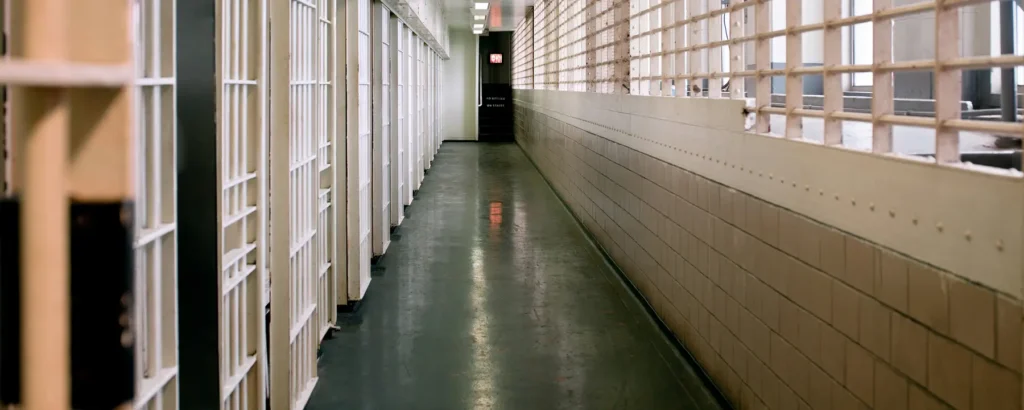
Understanding what happens during this first week can help reduce anxiety and allow inmates and families to prepare for what lies ahead.
Arrival at the Federal Prison
Most federal inmates arrive at their designated institution through the U.S. Marshals Service. This may happen after time spent in a local jail or a federal transfer center.
Upon arrival, inmates go through the Receiving and Discharge (R&D) process, which is the intake system used by the Bureau of Prisons.
During this process, staff confirm the inmate’s identity, collect personal property, and begin the administrative processing that officially places the inmate in BOP custody.
If you want to understand how inmates are assigned to specific facilities before arrival, see our guide:
What to Do Before Sentencing.
Property and Intake Processing
During the first day or two, inmates go through several intake procedures that may include:
- Fingerprint verification
- Photographs
- Medical screening
- Mental health evaluation
- Security classification review
- Issuance of prison clothing and identification
Personal property is reviewed and limited to items allowed under BOP policy.
Staff also verify information from the inmate’s Presentence Investigation Report (PSR), which plays a major role in determining custody classification and housing placement.
Learn more here:
What Is a PSR and Why Is It So Important?
Housing Assignment
After intake processing, inmates are assigned housing based on the institution’s layout and the inmate’s classification level.
Housing varies depending on the security level of the prison:
- Federal Prison Camps – dormitory-style housing
- Low security prisons – cubicle or dorm units
- Medium security prisons – cell-based housing
To better understand these differences, read:
Federal Prison Camp vs Low vs Medium Security.
Admission and Orientation (A&O)
Within the first week, inmates attend Admission and Orientation (A&O), a series of meetings and presentations explaining prison rules and available programs.
Topics typically include:
- Institution rules and disciplinary procedures
- Available work assignments
- Education and vocational programs
- First Step Act programming
- Medical and mental health services
- Visitation procedures
A&O is designed to help inmates understand how the institution operates and what opportunities exist during their sentence.
Programs introduced during orientation may include opportunities to earn First Step Act time credits.
Learn more about these programs here:
First Step Act Programs in Federal Prison.
Work Assignments
During the first week or shortly afterward, inmates are usually assigned a work detail.
Work assignments vary by institution but may include:
- Food service
- Maintenance
- Warehouse operations
- Landscaping
- UNICOR factory work
Work assignments are an important part of prison life and may influence program participation and daily schedule.
Phone, Email, and Commissary Setup
During the first week, inmates begin setting up communication systems that allow them to contact family members.
These systems may include:
- BOP telephone system
- TRULINCS email messaging
- Commissary account access
Families often begin sending money for commissary purchases once these systems are active.
Meeting the Unit Team
Within the first week or shortly thereafter, inmates typically meet their Unit Team, which includes:
- Unit Manager
- Case Manager
- Counselor
- Unit Officers
The unit team oversees many aspects of an inmate’s incarceration, including:
- Program placement
- Work assignments
- Custody classification reviews
- Release preparation
Inmates interested in programs like RDAP should raise the issue early with their unit team.
Learn more here:
RDAP in Federal Prison.
Planning for Release From the Beginning
Although the first week focuses on adjustment, experienced inmates understand that release planning begins immediately.
Participation in programs and maintaining a clean disciplinary record can affect eligibility for:
- First Step Act earned time credits
- RDAP sentence reductions
- Halfway house placement
- Home confinement
Developing a release strategy early can significantly affect how much time is spent inside prison walls.
For guidance on this process, read:
Writing a Release Plan.
How Prison Law Firm Helps
The federal prison system is complex, and many inmates and families struggle to understand how to navigate it.
Prison Law Firm assists with:
- Federal prison designation strategy
- First Step Act credit calculations
- RDAP eligibility
- Administrative remedy filings
- Halfway house and home confinement planning
- Supervised release preparation
If you or a loved one is entering federal prison, understanding your rights and opportunities early can make a significant difference.
Contact Prison Law Firm for assistance.